Feeds:
Posts
Comments


After my last post, I did a lot of thinking. I’ve learned some important lessons. This is what I came up with.

1. Never post an opinion piece in the wee hours of the morning.

2. If you’re putting your opinions out there, you’d better be ready for the fallout.

3. Read, revise, read, revise. One wrong word choice can completely alter the way your piece is perceived.

4. Timing is everything.

5. Realize that many will mistakenly think you’re writing about them, even though you’re not. One event might trigger you to reflect on a bigger picture, but they won’t know that. For example, you might see a mother reprimand her child in a store. Later, you think about similar situations taken to the extreme, and you write about the verbal abuse of children. You aren’t writing about the mother, but her actions caused an idea to snowball in your head.

6. Words are power. They can build up or break down. Exercise caution.

7. On the other hand, making people stop and think about something is worth the risk of making them a little uncomfortable.

8. If I worry all day because I suspect I’ve inadvertently hurt a friend, then perhaps it wasn’t worth writing.

9. Without passion, writing falls flat. Sometimes, we must draw on personal experiences for that passion, no matter how difficult that is.

10. Even the best journalists can recall times when something they’ve written got them in hot water. It might even be said that you can’t be good if you don’t occasionally take people out of their comfort zone. Rosie DiManno at the Toronto Star immediately comes to mind. If I’ve crossed a line, then at least I’m in good company.

How many times have you heard someone say they bought themselves a certain item because they “deserved it?” How often have you said it yourself?

It’s called “entitlement.” In its most innocent form, it’s the inspiration for occasional things we bestow upon ourselves to reward our accomplishments: the designer purse, the top-notch golf clubs, that rich dessert. At its worst, entitlement becomes demanding. You deserve something simply on the basis of being YOU, not because of anything you’ve earned.

Entitlement is a relatively new phenomena, a by-product of a capitalist society. Our parents never experienced it at all. To them, the only things one could “deserve” in life were punishments brought on by bad decisions; or high marks resulting from good study habits.

Books like “The Secret” promote the philosophy, but the simplicity of the thinking behind “entitlement” scares me. In some ways it infuriates me. It suggests that there is a magic formula to achieving whatever you want, to living the perfect life you want. Let me tell you that the formula is not foolproof, that you can only plan so much in your life; and no matter how deserving you feel, you may not get everything you want. Or, you may acquire them, and lose them in the blink of an eye. You may get knocked clear on your ass, with no hand reaching out to help you up. That, my dear readers, is the way life often plays out.

I’m sorry if that sounds harsh. I guess I’m coming from a bitter place right now. I am disillusioned with those who think they’ve discovered the secret to getting all they deserve and look with scorn at those who haven’t managed the same lifestyle. They imply that others have only failed because they didn’t do enough to “deserve it.”

Once, feeling we “deserved it” was the rationale for a lot of the purchases we made. We deserved them because we worked hard. But financial experts warn that that kind of thinking can lead to problems, and it’s a big part of why we’re in the mess we’re in.

Seriously, should “deserving” even be part of the equation? Do the people born in third world countries deserve to live a life of starvation and sickness? Do children serving in armies deserve to have their innocence robbed from them? Does one person deserve a quick, painless death, while someone else deserves to be systematically tortured, dying piece by piece, hour by hour?

There are certain things everyone deserves. We deserve the love of a spouse and a few good friends. We deserve the right to work, to be paid fairly, and to be able to use those earnings to better our lives. But there are people in countries who work 80 hours a week, just to earn money for the bare necessities. Is that all they deserve?

Life is not simply input equals output. It’s also about luck. Sometimes, it’s about being positioned in the right place. You have to know that somewhere, there’s a big roulette wheel spinning, and wherever we land, that’s our fate. We can have a long run of good luck, and then a sudden drop of bad fortune that we can’t recover from. It’s undeniably there, waiting to knock the wind out of our sails whenever we dare to say “I DESERVE THIS.”

FOOTNOTE I woke up this morning to a comment from Bob Doe (see below), and I realized that the way this blog came across may have offended a lot of people. That wasn’t my intention, and I apologize. Please read my response to Bob for a further explanation.

For several years now, I’ve had the pleasure of managing a wonderful online writing group called The Writing Bridge. Every month, we post a poetry challenge. Compared to many on the site, my poetry skills are mediocre at best, but we were low on entries, so I decided to write something on the one topic that occupies my mind right now: my hopes for our future. As it turns out, composing the poem couldn’t have been more timely. That future begins today.

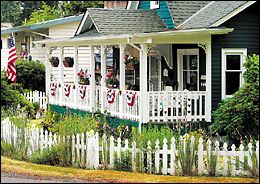
“A Verandah View.”

A verandah wraps around
the tiny place we’ll someday call home.
From it, we’ll watch the seasons pass.
Beside its rail, tulips and golden forsythia
will herald spring.
Fat peonies will hang low,
colonies of ants opening the petals wide.
And daisies. There will be daisies.

On warm mornings, we’ll drink coffee
on a verandah swing.
We’ll count chickadees,
and shoo away greedy blue jays
monopolizing the feeder.
We’ll pass the local newspaper between us
and plan our day.
Weight of worry lifted, we’ll be light as air,
free to write, to paint, to imagine.

On afternoons, we’ll walk by store windows
displaying local wares: crafts and art and homemade soap;
vegetables and fruit from the farmers’ fields.
The smell of fresh bread will lure us
to the village bakery; caving to temptation,
we’ll choose cinnamon buns or rhubarb pie
cooling in the window.

We’ll linger there with others,
laugh and philosophize
over the decadence of our favourite pastries;
the best places to travel; the latest production of
the local theatre group.

The importance of
“LIVING IN THE MOMENT.”

And in the evening, when dinner and dishes are done,
and we grow tired,
we’ll return to our verandah and
the gentle rhythm of the swing.
Chickadees gone, we’ll count shooting stars instead,
relax to the songbirds’ lullaby and
think the same thought each night:
“Aging is inevitable. To grow wiser,
we needed a verandah view.”

Spring has made a huge impact on the real estate market where we live. Suddenly this weekend, potential buyers descended upon us in record numbers. Yesterday, an offer came in. After three hours of negotiations, the deal was complete. While conditional on the sale of their home, it still carried an emotional impact. Suddenly, all of this is very real.

After months of trying to sell our home, actually signing the acceptance was surreal. The respective agents shook my hand in congratulations, but I felt no sense of happiness. We met the young couple who would soon call our home of twenty-four years theirs, and were surprised to learn we already knew them (sworn to secrecy on this for a while but more will be revealed later). I couldn’t help but be happy for them and their obvious excitement.

They left, and then it hit me. I bawled my eyes out.

Change is always a challenge, but it’s particularly difficult when it’s under duress – not so much a real choice, but something crucial to your future. In our case, there isn’t a whole lot of time left to improve our financial footing for our retirement years.

What’s amazing, though, is that once you step out of your comfort zone, the choices available to you seem endless. Where do you go? Do you rent or buy? Buy something temporary, with an eye to a retirement move, or buy something you will want to live in forever? What about house-sitting? A small piece of land up north with a plan to build later on? A fixer-upper?

Having our roots ripped from the ground is a huge adjustment, but maybe, just maybe, it will allow us to feel more adventurous, less encumbered. Free of preconcieved notions about our future, we may end up re-inventing ourselves in the process. And if we’re lucky, maybe someday there will be the perfect little home with a verandah view.

I’ve never really been a morning person. Sure, I can fake it when I have to, jumping out of bed at the first sound of the alarm, and moving through my “to-do” checklist like a “Stepford Wife” model of efficiency. But I’m moving just to stay awake. Sit me down for two minutes and I’m apt to nod off again. If it’s up to me, it’s late to bed, later to rise – usually a very civilized nine-thirty.

For the past ten days, I’ve had no choice in the matter. My husband has started a new job, and since he’s still on crutches, he needs my help in the morning. Otherwise, he’ll end up “ass over teakettle,” as his dear mum used to say. And because this will be his schedule indefinitely, I’m forcing myself to stick to it too. It gives me more time to think.

Now that spring is here, our home is on the market again, and I spend my days either compulsively cleaning the house to impress prospective buyers, or searching online for our next place to live. I feel like an anxious little mother robin, trying to figure out where to build her next nest.

We’ll be downsizing, and the verdict is out on whether we’ll move further into the country, where homes are less expensive, or closer to urban centres, where there are more job opportunities. Weighing the pros and cons of each is exhausting, and it’s tinged with a sense of loss. This move is based on practicality, not simple wanderlust, and so far nothing I’ve seen online makes the decision any easier.

It was beautiful outside this morning, and a moment of lucidity hit me when I carried my husband’s coffee to his car and reminded him to drive safely. The reality is that each day that passes is one less in this much-loved country home, and I’m not taking the time to appreciate it. So I walked inside, poured myself a coffee, grabbed the novel “Precious,” and joined my dog, Cadeau, and cat, Cleo, on our backyard deck. I’m glad I did.

By now, everyone knows the story of Precious, based on the attention generated by the screenplay. It is a story about survival against all odds, and the power of self-esteem. The heroine picks herself up from the worst of circumstances and begins to build a new life for herself. The last few pages of the book are pieces written by the girl and by her classmates, other young women struggling to get on track. I read those last pages this morning, and it set the perfect tone for my day.

I closed the book and looked around me, trying to remember the last time I gave myself permission to do this, just sit outside on an early spring day rather than plant myself in front of the computer or rush to finish chores. Why have I wasted these so many mornings when I could have been here, feeling the sun and listening to the birds on my backyard deck?

On our first day in this home, I remember waking to their singing. It was a striking change from the city, and I wondered if I’d ever be able to sleep through their early morning cacophony. Over the years, I’ve come to take their concert for granted, but today, I heard them again as if for the first time. I tried to identify the source of the diverse dialects. A blackbird atop the birch? The small yellow songbirds high in the willows? The killdeer on the slope at the back? The robins near the front of the house, gathering materials for their nest? There were so many more whose names I never bothered to learn.

I felt a wave of regret, but shook it off. Like the heroine Precious, we all move through different chapters in our lives. Sometimes, we’re pulled there, kicking all the way. Leaving the familiar for the unfamiliar is never easy, but it comes down to this: we can choose to remain mired in the past and mourn its loss, or we can rejoice in all the blessings we still have and look to the future. No matter how uncertain life can be, there will always be sunny April mornings, and the birds will still be singing their morning song.

I’ve been distracted by life issues for a while now: my husband’s latest (and hopefully last) foray into reno work; our house back on the market; a friend’s lengthy illness; the crash of my PC’s hard drive and the demise of my laptop; personal health issues; my husband’s ankle surgery in the very week we listed our house, and the start of his new job while still on crutches. Have I said enough? It’s all combined to make life crazy and exhausting.

I’ve wanted to write – I really have. In fact, every time an idea would hit me, I’d save its title here in my drafts. But that’s as far as it went. Every time I’ve sat down with the intention of writing, some other obligation would pull me away, and once again, my muse would be shoved to last place.. Not fair at all, but that’s life sometimes.

I’m h-o-p-i-n-g that things are going to get a little easier soon and I’ll return to writing regular entries, but for now, just know I’m not completely MIA – I’ve just been kidnapped for a while by life’s more “pressing” issues.

Stay posted…..and enjoy spring!

Tonight the world witnessed not only the brilliant performance of a Olympic figure skater, but one of the most poignant displays of courage ever seen. Just two days after her mother’s death from a sudden heart attack, Joannie Rochette took to the ice in the women’s short programme, and skated in her honour.

Commentators at the Olympics told stories all week of the closeness between Therese Rochette and Joannie, that her mother was a hard honest critic but also her staunchest supporter. Mere hours after arriving in Vancouver to watch her daughter compete, Therese Rochette was dead. She was only fifty-five, and had no history of heart trouble.

One can only imagine the shock of her loss, and the irony of such sorrow at a time that should have been the high point in Joannie Rochette’s life. And the inevitable question arises. How did this young woman find the courage to put her sorrow aside tonight and do what her mother would have wanted?

It wasn’t for lack of feeling. The tears broke through the minute her programme ended, and she bent over, hands on knees to regain her composure. Around the world, hundreds of thousands of people, immeasurably moved by her performance and personal strength, wept with her. Still, she never crumbled, didn’t collapse in grief as many expect we would under the circumstances. Instead, she stood back up, straightened her shoulders and graciously thanked the crowd, who were by then on their feet. The ovation and outpouring of love must have seemed surrreal. She skated towards the place where her coach stood, and it was only then that the world heard her sobs.

The late Ernest Hemingway called courage “grace under pressure.” We witnessed it tonight in Joannie Rochette. and I doubt any of us will ever forget it.

Your grace and bravery inspired the world tonight, Joannie. Somewhere, your mother is smiling.

Valentine’s Day is the yearly event that causes more headaches and heartaches than any other. Some may disagree, saying that Christmas is more stressful, but I’d bet my best red lipstick that more psyches suffer on February 14th. than on any other day of the year.

Think of it. The idea alone is masochistic. It’s the day chosen to show people how much you love them. Conversely, if you receive no such declaration, you may assume that no one loves you. It’s a logical deduction, even for a child.

Speaking of children, flash back to that brightly covered box in the front of the classroom, the one stuffed with carefully chosen paper Valentines? Remember how you waited with anxious breath for your name to be called, how everyone counted their cards, perhaps spread them out on their desks for others to admire? What must have been going on in the head of the classmate who received no cards? What a harsh reality for a child! Who knows what residual complexes remain once they become an adult?

I sympathize with people who are alone on Valentine’s Day, caught up in the melancholy envy of those in love who are out celebrating. But here’s the clincher: being in love does not guarantee Valentine’s Day will hold any romance, and relationships can be put to the test. I’ve learned that the hard way.

Now, don’t misunderstand me. I love my husband dearly, but romantic expressions of love are not his strong suit.

His proposal to me was muttered under heated breath when, at 17, he pressed me against my parent’s back door for a goodnight kiss. “You’re gonna marry me, right?”

The budget for my engagement ring was negotiated between us. He would spend the proceeds from the sale of some musical equipment, not a dime more. I was too thrilled with the prospect of being engaged to dwell on the budgetary constraints.

To be practical, my wedding night was spent in our new apartment, rather than a hotel room. His best man and ushers had stayed there with him the night before, and the place looked like a charity bazaar after a three-day blitz. In the corner of the bedroom sat a partially dismantled car engine, evidence of his latest project.

Have things changed since our marriage? Over thirty-two years have passed, and my memory may not be the sharpest anymore, but truthfully, I can’t actually recall a Valentine’s Day that was the kind of romantic surprise women dream about. Therein lies the problem. Women fantasize about such things all their lives, but men are just not hard-wired on a parallel path.

I observed the “out-of-sync” interplay between my parents for years. Mom would watch soap operas where men planned extravagant and imaginative surprises for their loved ones; but Dad was another story. He’d leave a greeting card up on top of the fridge for her to see. Sometimes, there would be a heart-shaped box of chocolates with it. Once in a while, there would be a cheque inside the card, and his name scrawled hastily, devoid of any personal message. Of course, my mother did less. She was from an age where ladies did not bother to even reciprocate Valentine’s gifts. I can’t imagine how he would have reacted if she had.

So, though I’ve never really expected grand gestures from my own husband for Valentine’s Day, secretly, I’ve always hoped. I’d see the romantic gift a friend would receive, and I’d grow wistful.

As V-day approached, I’d inevitably become more and more anxious, gearing myself up for the inevitable letdown. Sometimes, he’d completely forget. Other times, he’d say he was planning various things for months, then he’d go on to tell me why none of it could be accomplished. To be honest, I believed him. An “event planner” he’s not.

“I wanted to take you somewhere special, but couldn’t decide where to go.”

“I was going to buy you roses, but they seemed such a waste of money.”

“I thought you’d rather pick something out yourself.”

“I didn’t know what you wanted.”

“I wanted to get you something sexy, but I figured you wouldn’t wear it.” Now, there’s a story behind this line. Years ago, he ventured into an erotic clothing store and bought me what the salesperson claimed was a negligee. Actually, it was four strips of very sheer blue material, two down the front, two down the back, perhaps three inches wide at best near the upper end and wider towards the bottom. Ribbons attached the strips to each other. Problem was, I could only wear it if I stood stock still. One twist and those two strips down the front no longer covered the “essentials.” At a time when two little sons might run into our room at any time during the night, it wasn’t too practical. We both laughed, he a little less heartily, and he’s shied away from sexy purchases ever since.

Another time, he brought me home a card and lovely wrapping paper but no gift. “I couldn’t find anything good enough,” he said, frustration dripping from every word. He seemed to have developed a “tic” while he was out too.

Sometimes he says, “What do you feel like doing for Valentine’s Day?” Of course, what I want is for him to plan it for me. If I actually suggest that, he looks like he’s about to have a stroke from the pressure of it. He’ll say “I thought we should go out for dinner,” but he’ll say it that night, at 5:00 P.M., when there’s no hope of getting reservations. Then he’ll squirm in remorse.

Once, we had a romantic dinner, and we followed it by going to a movie. “Total Recall” does nothing to keep the “warm and fuzzy feeling” alive, believe me.

But after all this time, I’m almost used to it. The truth is, he’s special in every other way that counts. He brings me tea and tells me I’m smart and beautiful all the time, even when I’m feeling like Phyllis Diller on her worst day. And I don’t think his lack of romantic inclination reflects anything more than an inability to recognize the special, small gestures that can be so heart-warming. In other words, big, expensive gestures occur to him, but limited by budget and circumstances, he flounders.

So, if Valentine’s Day is spent like so many other “dates,” I’ll be prepared. A dinner out if I make a reservation, followed by a tour around The Home Depot, and an early return home. Then, perhaps, a glass of wine each, a fast “I love you,” and we’ll each depart for our separate televisions. He’ll watch “This Old House” or The Antique Roadshow,” and I’ll watch a taped soap opera, probably General Hospital, so I can watch Jax as he plans a superbly romantic evening for his current lady-love.

If I grow envious, I’ll remind myself of what my husband said to me recently. He was removing wallpaper from a room, and he commented on the strong, unhealthy fumes from the stripper he was using. Then he added, “It’s okay. As long as I see your pretty face just before I die I’ll be happy”

Okay, so it sounds corny, but it goes a long way towards making up for Home Depot on Valentine’s Day

(published in the Globe and Mail, Feb. 14/05 under title: Valentine’s Day façade, Valentine’s Day feeling)

I’m angry today, the kind of angry that makes me want to throw on a placard and demonstrate on the busiest street corner I can find. What would the placard say? “I’m over 55, but I’m not dead yet! HIRE ME!”

The month started off so well: an article in the Globe and Mail, a ton of positive feedback, including personal emails, and a guest interview on a CBC news programme where I talked about the difficulties of being out of work. Messages filled my mailbox. People complimented me on my honesty, said I handled myself professionally, wished me well. But a job offer? Not even one – unless you count a couple of people singing the praises of multi-level marketing companies.

I even joined LinkedIn. It wasn’t actually my own idea, but something thrown out at me as more of a taunt during an argument with someone. It was like “Why haven’t YOU tried LinkedIn?” The implication was that I wasn’t trying hard enough to find a job, so I joined, wrote up a profile, included my work experience and links to this blog in case writing opportunities were out there, and joined a few groups. Then I sat and waited, and I realized why I’d never joined before. The problem is that while I’m able to “link” to a few people, I am virtually unable to ask for a reference from anyone there because the people I’m linked to are friends or casual acquaintances, not people who’ve worked with me. What are they going to say about me, other than personal things? Some have never even read my work. They can only guess at my capabilities.

In the meantime, I’ve continued to apply for jobs at all ends of the spectrum. One person who responded to my article suggested I don’t apply for anything “beneath me,” because of the sheer number of applicants for less qualified positions. I understand her point, but it hasn’t stopped me because I can’t pass anything up. I’ve also applied for lots of work that I’d be perfect for, but so far, I seem to be the only one believing that.

And here’s the thing. No matter what anyone says, the longer I go without a job, the more I know that this IS about age. If I’d been twenty or twenty-five, I would have been hired long ago for some of those lesser-paying jobs. If I’d been under forty-five, I’d have at least been called in for interviews for some of the better jobs. I know it as well as I know that underneath this dark brown hair hide grey roots.

So I’m frustrated and furious.

They say that no group is valued less in western society than older women, and more and more, I’m beginning to believe it. We’re past our prime and for many, past our usefulness. We can no longer bear children and our figures aren’t perfect. We go through menopause and have “unsightly” hot flashes in public. If we are emotional, society thinks we are “losing it.” If we are strong, they say we’re “cranky old bitches.” Unless we want to volunteer and run ourselves into the ground (we’re always welcomed when the work’s for free), we are often ignored, even by our male counterparts.

There’s no industry where ageism against women is more evident than in movies and television. Actors are allowed to age but their love interests rarely are. And when we do see an ‘older” actress on the screen, the portrayal is sometimes ridiculous. Case in point: Erica Kane, from All My Children.

I’m a follower of soaps, and recently I’ve found myself more and more insulted and irritated by the way this character is being written. “Erica” is a fashion icon/television star/author/businesswoman/philanthropist, with ten marriages under her 20-inch belt, children in their thirties and a few grandchildren to boot, yet she’s seen as ageless, a tiny slip of a “girl” caught in a permanent time warp. The part has been played for over nearly forty years by Susan Lucci, now sixty-three years of age. Lately, she is batting her eyelashes and tossing her long hair over her shoulder, then finally falling into bed with Ryan, the early 30’s ex-lover of her daughter, the father of Erica’s grandson. Lost yet?

I’m 58, just a few years younger than Erica, and I find the current storyline extremely offensive. In fact, the lack of reality regarding Erica, the way she sees herself and how others view her, is turning me off the show entirely, and that’s after over thirty years as a faithful watcher!

Do the writers forget that people actually GROW in character as they age? Despite the fact that they’ve allowed Erica to develop some better qualities over the years, she is still coming across as a “sweet young thing.”. Her mannerisms are coy, flirtatious and affected. She is a caricature.

The viewers know she is in her sixties. Let her dress a bit more appropriately. Stop shooting her through a soft-focus lens. Don’t insult the viewers’ intelligence. Address the logical concerns that an older woman should be having. Have her worry about the younger women around Ryan. Have her look in the mirror and be concerned about her age. Bring in a storyline where she considers plastic surgery. Viewers know she’s had plenty. Have her talk about her grey roots. Show her having a bloody hot flash. Oh gosh, forget that. She’s long through menopause. Give her osteoporosis!

Why not make her REAL, make her HUMAN? I can’t be the only one who’s offended by the way this is going.

Nothing is as black and white as some employers see it, or as the writers on AMC write it. Women over 50 don’t whither up and die, but neither do they have to act like they did at eighteen to compete. We should be free to be ourselves, confident of our worth and believing that somewhere, someone still recognizes our value.

In the meantime, I need a job.

On Tuesday of this week, Haiti, long considered the poorest country in the Western hemisphere, was hit by an earthquake measuring 7.0 on the Richter scale. As people gathered to sit down for their evening meal, their world opened up to swallow them whole. Buildings crumbled. Cubans felt the tremors and knew instantly that two hundred miles away, thousands were dying.

Most of us watched, spellbound by the kind of tragedy few people will ever personally experience. Safe in our homes, we cried for the victims and looked for ways we could help, even if only in a small way. Many of us prayed and asked “Why them? Why, once again, is this impoverished country forced to suffer?”

It was a rhetorical question.

Not long after the earthquake, though, someone sought to answer it. Pat Robertson, the host of the “700 Club,” spoke up and declared that just as God had punished Americans with Hurricane Katrina, Haiti was now being punished for having a “pact with the devil.”

He was purposely vague, all the better to suggest to average folk that he was privy to knowledge that was beyond them. According to CNN, Robertson blamed the tragedy on something that “happened a long time ago in Haiti,” adding that “people might not want to talk about it.”

In a couple of brief sentences, Pat Robertson supplied an answer that would make a lot of people sigh with relief – those who need to have every event in life shoved into a box and labelled either “Reward” or ‘Punishment,” those who refuse to accept that there is anything in-between, no bad fortune, no “being in the wrong place at the wrong time.”

Life is simple for them that way, you see. These people live by rules and choose to believe that adherence to those rules assures them of every kind of success in life. It makes them feel safe. Most of all, it helps them to feel superior in mind, body and soul. It allows them to sleep, guilt-free, without thinking of those who suffer.

Remember now, Pat Robertson says that Haiti’s ancestors brought this plague of misfortune down upon themselves. Misery, in the minds of those “holier than thou,” is purely self-induced. That frees the self- righteous from feeling any need to reach out and help.

Recently, I experienced the vitriol of the self-righteous firsthand. I wrote about the difficulties of unemployment after fifty-five, and the turn our lives had taken since then. I was warned that the piece would elicit little sympathy, but I was fine with that. After all, sympathy wasn’t my motivation. I simply wanted the public to know that the problem existed, even though it was often hidden.

Over a week, the online essay generated 189 responses, and I was amazed at those that were not only critical of my husband and me, but self-exalting. I fully admitted mistakes, but some people only felt the need to expand on where I went wrong and where they went right. And I politely answered with, “how wonderful that you made such good choices and you’re now financially secure,” but I wanted to add, “but what’s your success got to do with the high number of older workers who despite their experience, are being passed over for jobs?”

I didn’t have to argue my point. Others rushed in to do it for me. But it got me thinking about some people and what motivates their responses to those who are less successful, whether it’s in regard to finances, careers, health, marriages, or family. And what occurred to me is this. Those who work so hard to appear superior are actually petrified. Way down, deep inside, so deep that they can’t even admit it exists, there is the fear that they don’t have things under control as much as they think they do. Admitting any past mistake, or learning that their perfect plan could possibly fall apart, is more than their egos can handle.

They tell themselves that they are at a good point in their lives because they have adhered to the rules of “good living,” that they’ve worked hard, been frugal, planned carefully, eaten well, gone to church, prayed for wealth and success, paid their tithe, and exercised regularly. It allows them to hold their head high and ignore the homeless person on the street. It keeps them guilt-free as they vote against every government programme that suggests a “hand-up” or “handout.”

And while tens of thousands in Haiti are buried under buildings and dying in the streets, it frees the self-righteous to look out their front window and say, with all confidence, “This is what I deserve.”

An online video of my interview with Mark Kelley is available here: http://www.cbc.ca/connect/2010/01/work-wanted.html

I enjoyed the experience very much. The actual interview was shorter than expected because one prior to mine took off in a whole different direction, and Mark couldn’t cut the person off. I guess that’s one of the drawbacks of live television. lol