Feeds:
Posts
Comments

popolivelargeHow do you know when a guy really loves you? An old song asked that question and suggested that it was “in his kiss.” But these days, kisses are doled out so freely that they’ve depreciated, so what’s the answer to that age-old query now? Is it in the romantic gifts of flowers, candy, or jewellery traditionally given on special occasions like Valentine’s Day? Is it in the gestures of support we get on a regular basis – the sudden compliment, the chores done ungrudgingly around the house, the much-needed dinner out?

All of these matter, but I may have found the definitive answer to whether your partner really loves you. It’s the extent he/she is willing to go to protect you from harm.

Now, many people have told me how lucky I am to have a “superhero” for a husband. He is devoted and protective, a “Saint Bernard” of a man. Standing six-foot four and with hands the size of a catcher’s mitt, he moves through life like a force of nature. Few people would ever challenge him on a physical level, and being loved by him brings a sense of safety and security. But there is one aspect to his readiness to protect that can have a downside. Occasionally, his reactions can be considered a little extreme. I know, because several years ago, he tried to save my life.

It was late-May, unseasonably warm, and I was in the kitchen preparing supper when one of our sons burst into the house, his shirt blood-splattered and his knuckles skinned. It was obvious he’d been in a fight.

It wasn’t anything that I hadn’t seen before. Life near a large suburban community carried its share of danger, and he seemed to have inherited his father’s reactive adrenaline surges when he felt threatened.

Before I had a chance to speak, he started telling me what happened. “I just had a fight with Matt*,” he said, closing and locking the door.

The news wasn’t totally unexpected. I knew my son’s temper and I knew Matt*. Even as a youngster, he could be trouble. Now that he was older, with the rumour of a tough gang of friends to back him up, he seemed a legitimate threat.

Our young “caped crusader” supplied a few more details of the altercation then jumped into the shower. An hour later, he left for work, but not before telling us to keep our eyes open for a strange car in the driveway that night. “Play it safe and keep the doors locked,” he said, only half-jokingly.

Despite our paranoia, the evening passed uneventfully, and soon it was time to turn in. Our bedroom was warm (we had no air conditioning at the time), so we left the windows open and the blinds up to catch the breeze. A ceiling fan added to the comfort.

Miles from the city, it was dark except for moonlight. I squeezed earplugs in to drown the regular sounds of stray cats, crickets and my husband’s snoring, and snuggled down for the night. Despite a few pangs of worry about our son’s safety, I finally drifted off.

I was asleep less than an hour when I felt my husband’s big “paw” shaking my shoulder. I was startled, only half awake, and my earplugs muffled his words. Irritated, I asked him, “What is wrong with you?” My first thought was that he was having an unusually intense dream. He was agitated, almost panicked, and covered my mouth to stop my questions.

More than once, I tried to sit up, but he pushed me back down. He was frantically whispering something, but what? Finally, I managed to get an arm free to yank out an earplug. “It’s Matt and his friends. They’re shooting at us,” he hissed. “They’re in the backyard.”

A loud and rapid-fire, “Pop, pop, p-p-p-pop, p-p-pop” filled the air. Still, the meaning of his words didn’t register. Unlike my superhero, my adrenaline had flat-lined in my sleep. I looked towards the two large windows in our room, and realized screens would offer no protection from the volley of bullets outside. In the space of a few seconds, my lack of understanding turned to terror. I couldn’t move.

Suddenly, the shots seemed to grow closer and louder, and my husband went into rescue mode. He started to pull me onto his side of the bed. The problem was that in the confusion, he wasn’t explaining why he wanted me there, and I was too stunned to think it out myself. He also couldn’t see well enough to move me carefully. In one fell swoop, he threw his arm around my neck, grabbed me by my head, and yanked me backwards, off the bed and onto the floor on the other side.

Together we waited, our hearts pumping wildly, until silence came. I’m not sure how much time passed before we decided it was safe to move. We were still too frightened to stand, too sure they were lying in wait. Finally, my husband slithered across the floor and made his way to the windows. He reached up from the side and was able to pull down the blinds, hiding us from our attackers. Then, he crawled his way to the doorway and turned on the light.

The source of our terror was right before us!

Floating high above our bed was a partially-deflated helium balloon, a souvenir from my husband’s birthday the month earlier. It had come loose from its doorknob mooring and taken flight. 

How can a helium balloon mimic the sounds of gunshots, you ask? Just get it caught in the blades of a ceiling fan.

My neck was a little stiff and sore the next day, and my husband felt pretty foolish, but one undeniable truth came out of it all. My husband will always protect me, even if he kills me in the process.

I guess that means he loves me.

~~~~~~~~~~

*Note: “Matt” is a pseudonym.

48149-main_fullI am exhausted. Not just sleepy, or tired to the bone, but exhausted on every level: physically, mentally and emotionally. Okay, that last part is an exaggeration. Emotionally I’m doing okay, though sometimes I wonder how that’s possible, considering everything’s that’s going on in my life lately.
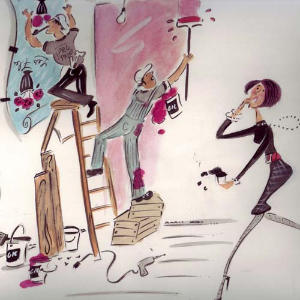
It’s made me a little impatient on some levels and I find it’s erupting in unexpected ways. This week, when no one offered to help me in a home improvement store, turned away from me in fact, I got so angry that I found a cart, lifted a huge pail of tile paste (nearly 50 pounds though it felt like two hundred to me) from the floor into the cart myself, grew angrier when no one helped me get it into the car, and hurt my back stubbornly trying to do it all myself.

All week long I have been reminded of that decision every time I move or twist a certain way or try to lie down. It was foolish at my age and with my health issues, no matter how frustrated I was.

My irritability surfaced again when I became part of a discussion on infidelity. A writer friend made the point that monogamy wasn’t natural in the animal kingdom and that people needed to remember that humans are most closely related to chimps, therefore monogamy is also unnatural in humans.

The flat-out statement that we should accept infidelity is more natural than monogamy because of our connection to the animal kingdom bothers me. It provides a pat answer to a complex relationship that’s been around for thousands of years. Nothing is ever that simple – is it?

I wrote a response and realized I sounded judgmental and more than a little “pollyanna-ish.” Here, though, giving such a strong opinion seems more appropriate. After all, it is my blog, correct? lol

The original discussion began started with a reference to an online dating service for married people who were interested in casual relationships outside their marriage. We were asked for our opinions. This is my response:

Personally, I think for one person to be unfaithful behind their partner’s back is unconscionable. If it’s a joint decision, I wonder why they bother to be together at all, but at least they aren’t hurting each other. Society, possibly. Any children they may have, certainly, Their families, no doubt, but each other, probably not.

I could never go so far as to excuse infidelity on the basis of humans being mere animals, most closely related to the chimp. I do not see infidelity as a naturally occurring instinct, suggesting that there is no choice involved. It seems to give people permission to do what comes naturally, what they were always “meant to do.”

More likely, I think infidelity occurs as a result of people marrying for the wrong reasons: because the prospective spouse is attractive, or fun, or society tells them it’s time, or there’s a child on the way, or the person has a bright future professionally. We have these images of “Barbie and Ken” in our heads, with perfect kids who will never stray. We imagine our lives will be like the ideal ones we see on family-oriented shows, with money in the bank, a membership at the golf club, and problems no worse than those on Leave it to Beaver or Family Ties. All of those expectations set people up for a load of disappointments, and they sometimes realize that it was the promise of the future life they were in love with, not the person they married. It may only be one person who’s disillusioned, but that’s all it takes.

The bottom line is, I believe when two people are really right for each other (and it does take both of them) they find a way to grow together over time, not apart, and the urge to be unfaithful is practically non-existent for them.

Let’s face it. Getting married is much too easy for such a huge step. For many people, the only difficulties are around the ceremony and finding the right dress and venue. How much better it would be if getting married required the same kind of work and preparation as our careers. Maybe then they’d be better prepared to make and honour their commitments to be faithful.

LOSING CASEY

casey-the-gentle-giant6

LOSING CASEY (2006)

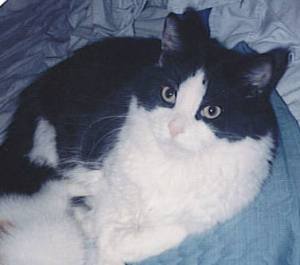
We are a family of cat lovers, and the one we love most is dying.

His name is Casey.

For over a year, Casey has not been well, but we are stubborn owners, and we have faithfully medicated him and pampered him to prolong his life. We have tried to believe in miracles, and sometimes, Casey has almost convinced us we should. Finally, he has developed an illness that is stronger than we are. He has cancer, and we know his time is short.
Once a giant furball of nearly twenty pounds, he is now less than half that. Steroid medication is the weapon of choice as we fight this newest enemy. It boosts his appetite, but only makes his death all the more inevitable: despite having a voracious appetite, his body is wasting away.

We’ve finally agreed that soon we must call our compassionate veterinarian and arrange to end Casey’s life. We’ve decided to keep Casey here on the property he loves. We will build a cedar box to hold his body and bury him under a shade tree at the back.

Casey hasn’t moved much in the past two days; has, in fact, just stayed in his bed downstairs and left only to walk the short distance to his litter box or his food and water. But tonight we decided to take his bed outside and let him enjoy the outdoors for a while. We placed the bed on the deck, his food nearby. We did not expect him to stray. We underestimated his will.

Within five minutes he managed to leave the deck and we found him lying in the thick grass near the neighbouring farmer’s field. It’s always been a favourite spot of his, a place where he could spy mice or butterflies, a place where he could explore for hours. I shook my head when I saw him, amazed that he was able to walk that far. My husband told me not to worry, that Casey wouldn’t go anywhere else, and he left for his soccer game.

Several times I checked Casey in the next half hour, and he hadn’t moved. When it started to grow dark, I went outside to bring him in and spotted him turning the corner around the shed near the neighbour’s field. He was no more than seventy-five feet away. He was moving slowly, and I didn’t expect him to go far.

I was wrong.

By the time I got down the deck stairs and to the spot where I had seen him, he was gone. There was only one place he could be, and that was in the farmer’s field of tall hay. In the distance, I could hear another farmer who had already begun harvesting. All I could think about was the idea of Casey dying deep in that field, then being chopped up by a harvester.

I began to call his name, walking up and down the fence that divides the farmer’s land from ours. Our other two cats, Cleo and Gypsy, came as if to join me in my search. I grabbed a flashtlight and a bag of dry cat food from inside the house. My left hand shook the bag of cat food up and down, the universal call to cats to come and eat. My right hand held the light, and with it I pushed the deep foliage and hay aside best I could, aiming the beam towards the dense roots. It was too dark to climb the fence and try to make my way through the hay myself. Instead, I called his name over and over, shook the bag harder and harder. I listened for his “meow,” but in the past few days it had been barely audible. And I realized that if he found the strength to make his way into the farmer’s field, he likely didn’t have strength left to answer by meowing, let alone make his way back to our home.

Suddenly grief overwhelmed me. The image of the dead baseball players walking into the farmer’s cornfield in “Field of Dreams” played through my head. Casey was walking into his field, and would not come out again. It fit in perfectly with the almost “mystical” quality we’ve always seen in him, the feeling that he was more than just a cat.

I searched for over an hour, until my bad knees were cursing me and my tears had exhausted me. Then I came inside, accepting the death Casey had chosen, but dreading having to tell my family. I sat at my computer, wanting to say something, but feeling too tired and a little foolish for my emotional outburst. And I said a prayer, just a little one asking that he come back, so we can be nearby when he dies, so that we can lay him under the shade tree.

Resigned to the loss, ten minutes later I walked back outside to call my other two cats inside for the night. The deck was dark. I flicked the outside light on, and there was Casey, in his bed, looking up at me as if to say “You needn’t have worried. I made it back.” I picked him up and cried my relief into his fur.

I ask myself why the death of a pet can be so hard. Perhaps it is because those of us who believe in an afterlife don’t see death as permanent; we tell ourselves we will see our loved ones again. But no one talks about the pets that have won our hearts throughout our lives. No one mentions an afterlife for them. There is no promised reunion.

People will say it is silly, that I must be unbalanced, or at the very least neurotic to have such a reaction tonight. After all, he is only a cat, they will say.

But then I remind myself that they don’t know him, so how can they possibly understand?

EPILOGUE

A few days later, we knew it was time. As much as he wanted to get outside and lie on the grass, Casey could no longer walk.

He was upset on the way to the vet, but too weak to protest very much. When we brought him to the back of the hospital, near the operating room, he sensed something was up. We placed him on the examination pad and he even lifted his head, wondering about the light that was shining down on him. He was very alert, looking at each of us as we spoke to him. The end was very peaceful for him.We wrapped him in the towel we’d brought and took him home.

My husband had already finished his coffin just before we left. My son found a large amount of blue velvety blanket cloth, the kind they use in expensive hotels. We took apart an old pillow to pad the interior and I cut the blanket to line the coffin’s top and bottom.

I shampooed his fur and blew it dry to make it fluffy. I told myself that people would think I was nuts, but doing it felt right. He deserved it. He was the most fastidious of cats before he was sick, and I’m sure he hated feeling so dirty and unkempt in these past few months.

Casey barely fit into the coffin. He died at little more than 7 pounds, his normal weight being close to twenty. He was such a long cat that the coffin couldn’t have been an inch shorter.

We picked flowers and lay them in the coffin around his head and feet.

My son and husband dug a grave next to the hedge at the side of our property where Casey liked to sleep, the same place he’d disappeared to that night. The ground was really hard and it took hours to get it deep enough.

By the time he was buried, we were emotionally exhausted. Maybe it’s because we give ourselves permission to mourn our pets the way we want to, whereas when we lose people we love, we try to put on a brave face. We worry more about upsetting the person who is dying, as well as others around us. We also are fully aware of the person’s suffering, and we can’t bear to see that. And if we are religious, we find comfort in knowing they are going to a better place.

It is different with a precious pet. Watching Casey suffer, knowing that he didn ‘t understand why it was happening, was heartbreaking. Part of us went with him. We can only hope that it’s true what some people say, that our darling animal friends are part of our afterlife, and Casey is there waiting for us, eager to play again.

renovation-roulette-1-mIt’s occurred to me that one of the greatest tests of a marriage is that dreaded of times, the renovation period. If your home is over twenty years ago, it can seem a neverending cycle, and if either one of you is even borderline attention-deficit, that’s the time it will show up in spades.

Such is the case in our home. My husband has the energy and ambition of two men half his age.  That can be both a blessing and a curse. Understanding his thought patterns can be like following a billiard ball as it richochets from ball to sidewall to pocket. He’s knocked a kitchen wall down at one in the morning because of a sudden inspiration. He’s started gigantic projects without planning the workspace or storage for such a huge undertaking.  At times, it makes me want to pull out my hair, but compared to women whose husbands lack that kind of confidence, I consider myself lucky. Point my husband in the right direction, clear an area for him to work,  remove all the breakable items around him, and he’s off to a great start. But leave him to fend completely on his own while I go and try to write? Don’t count on me getting much done.

Twenty-odd years ago, I read an article called “The Truth About Men and Housework.”  It was written long before “political correctness”  guided everything in print, and we thought it was hysterically funny because in my husband’s case, at least, it was completely true. One of the things it stressed is that by their very nature,  men prefer to work “in packs.” I remember one part in particular that went something like this:

“Your husband will be three steps up a ladder and call you to hand him something he forgot to carry up with him.  Don’t worry. You can finish your shower later.” 

The writer wasn’t suggesting laziness throughout the piece, but a man’s need to have someone nearby to comment on their work and assist them in some small way, speeding up the process.

That’s the pattern my husband and I have settled into, and it works for us.  Perhaps it will for you too. I am much like the operating room nurse. I keep track of the renovation “instruments,” otherwise he’d spend a couple of hours of the day searching for his measuring tape, or the Phillips screwdriver he just had in his hand, or the dropcloth he had yesterday. I’m the one who runs for the paper towel if he splatters paint . I hold the light up so he can see if the drywall paste is on smoothly. I constantly shift things around him as he makes progress in the job, all part of my own obsession to keep things under control. It works for both of us. I stay calmer and he avoids tripping on things and breaking an ankle.  After all, he’s a big guy, and if he falls, he falls hard.

He’ll also work non-stop, forgetting the time. I remind him to come and eat, and I bring him tea and cookies when it’s time for a break.

Now, before you start thinking that this is all a little too “Stepford Wife-ish” for you, I should tell you that it’s not always sweetness and light. When he messes up badly or loses something for the tenth time that dayand his frustration level skyrockets, that’s my cue to let him howl at the moon alone.  His tirade generally doesn’t last long. Ever heard of a surgeon carry on an operation alone without the surgical nurse to hand him the scalpel?

Not to worry though. Unlike the surgical assistant, I stop short of wiping his brow.

sadness-anger1My good friend Tony May began a discussion today in our writing group on the subject of “global anger.” He voiced his concern over the way violence seemed to be escalating, even in small towns that up until now, were simple sleepy hollows. He asked for ideas on why we thought it was happening, and I was surprised at the response that poured out of me.

I wanted to share it here (with apologies to Tony for running with his idea):

If there’s a cause of the escalating violence in our world, it has more to do with the isolation people feel in their anger, rather than any particular thing that’s causing their anger. People are losing their sense of community, and with that comes a fear of losing control and a lack of trust. Individual rights to vent anger freely, have taken over the rights of others who are the target of that anger, or simply witnesses to it. Everyone is affected by it.

Too few people are willing to cut anyone any slack these days. They want to be angry because it makes them feel in control, or superior, or powerful, and most definitely, righteous. They’ve learned to take pleasure in cutting others down to size. They are more eager to believe the worst of people than they are to give them the benefit of the doubt. It explains the success of tabloids. People are more afraid of looking like fools for being “too kind” than looking unkind for judging too hardshly or unjustly. Suspicion and paranoia reign supreme, and the media has caused it to spread like a disease.

When we see educated people looking down their noses at the undereducated, or people hating another ethnic group simply because they’ve congregated in large numbers in one area and opened businesses selling their own ethnic food, food, and clothing; when you have religious groups who believe that prayer brings personal and financial success, so anyone who fails in that area must deserve it because they can’t be living as God intended; when you have older people resenting younger ones because they lack the life experience to appear so self-assured, or when you have people thinking less of you because somewhere along the line you failed at the big “American Dream;” when you have people ask you 1. what you do for a living? 2. where you live? 3. and what college and college team your kids have made it into? and you’re keenly aware that if your answers aren’t right, they stop listening; when your success or failure is measured by your children’s success or failure, and kids value their parents on the basis of “what they’ve achieved,” or “what they own;” and parenthood becomes just one more area where you feel you have to compete; when the “have nots” are assumed to be lazy and undeserving; when people are so effing scared to be honest about their feelings for fear of how others will judge them, well, that’s when you end up with the mess you see right now.

Eventually, it won’t necessarily be the anger behind a gun that will cause deaths. It will be the anger we hold onto that may as well kill us outright. It can become the reason for some people’s existence – a way to stand their ground, their swords drawn and ready for dangers they perceive will come their way. Letting that anger fester and build is a conscious choice, just as they say being happy is a conscious choice.

In the final analysis, all we can control is our own reactions to the shit life hands us. If we can’t learn to put things into perspective, and hope the next generation follows our lead, then I fear that someday, Mad Max’s world won’t seem all that far-fetched.


cheese-bun1This is an oldie, published in Moondance: Celebrating Creative Women in June of 2004. While we deal with the current recession, I can’t help but think of it again, and remember that we are often luckier than we realize.


Once in a while, when I’m feeling particularly blue and disillusioned with life, something happens to open my eyes. Call it an epiphany, if you will, but it’s a blessing for which I’m thankful.

Not too long ago, I had such an awakening. We were riding the tail of a very stressful month, filled with uncertainty and worry around recent employment changes, and emotions in our home had run the gamut. Finally, we decided to shake off the negativity that enveloped us, and recapture some of our usual fighting spirit. Whatever fate brought, we would focus on what was right in our lives, rather than worry about what we couldn’t control.

That night, the wisdom of our decision was proven to me in the guise of a solitary woman who stood behind me in the grocery store. I had come for just a few items, but being a bargain hunter by nature, I had taken advantage of mid-week bargains. I placed my carefully selected items on the grocery belt; two cases of Coke, two containers of ice cream, and two bags of potato chips, far from necessities, but all discounted; inexpensive laundry detergent; cat food; milk; bread; three bags of coffee. As I faced the the cashier scanning the bar codes, my eyes glanced left and downward and were drawn to pair of feet wearing flowered neon pink socks. The only protection between her feet and the cold November ground were a pair of cornflower blue flip flops.

From the corner of my eye, I gazed upwards. Bare legs, a printed skirt and shirt, and over it all, no coat, but a transparent green hooded raincoat. She stood ramrod straight, a large rectangular floral bag gripped tightly in her hands.

Must be eccentric; maybe an artist, or even a writer; someone who cares little of outward appearances, I thought to myself.

I handed the cashier the money for my purchases, and the woman placed her order on the belt: a single cheese bun.

“That will be fifty cents please,” I heard the cashier say, then “Do you want a bag?”

“No. Thank you anyway,” the woman answered, as she placed the coins in the cashier’s hand.

From over my shoulder I turned quickly to catch a last glimpse of the woman, and then I saw what was not apparent at first. For she didn’t wait until she was outside to hide her hunger from the rest of the world; there, in the suburban grocery store, she began to eat.

In that second, I knew the truth, and I sensed her shame.

In the parking lot, I quickly lost sight of her as she moved on foot between the cars. I wondered how far she had to travel on such a cold night, dressed so poorly. Then I looked down at my own clothes: the warm leather boots and brown lambskin coat, my carefully matched purse and gloves. I opened the trunk to my car, still like new, every option possible, all shiny black paint and chrome and tan leather, insisted on by my indulgent husband. I drove home, her image branded into my memory.

Somehow, she seemed abandoned, a solitary lonely woman. Beautiful once, and would be even now if sorrow and hard times weren’t so indelibly grafted into her skin. Perhaps younger than I, but I couldn’t be sure. Long, gently curling hair. Clear blue eyes which stared straight ahead. Tall and slim, good bone structure, she could have been a Hollywood actress on a set. But this wasn’t Hollywood.

Did someone love her once? Had she ever known the joy of a small child’s arms around her, or the warmth of a grown son’s hugs and the words “I love you, Mom.”

Did she one day have a husband like mine, who even then, despite work worries, was home in a cold garage, doing his own version of “Junkyard Wars” to create a closed cabin for his old snow plow? A husband who jokingly calls me “Highness,” who makes love to me and brings me tea, who tells me I’m beautiful and smart every day of my life? Has she ever loved someone who could make her laugh until she cried, who shared private jokes and silly stories with her?

If she did, was the sorrow I sensed the mourning of what was lost?

No matter what else life has dealt me, I have been lucky enough to know such love. I watch my husband from afar, and sometimes, his thick hair, now graying, seems once again the color of honey. The years disappear, and I see the vulnerable boy I fell in love with so long ago.

So, thank you, mysterious lady. You have helped me see once again how truly blessed I am. I hope that some day fate allows you to feel a similar joy in your own heart.

42-207336911A short “what if?” piece, purely fictional. Do you ever imagine how your life would change if you suddenly learned you were dying? I do. This is just part of what I imagine regretting.

“Carpe diem.” I know what it means but it’s made no difference. I’ve lived each day, each year on delay, as if I will exist forever. I’ve been Scarlet O’Hara, following the mantra. ‘Tomorrow is another day.” I’ve been a fool.

I’ve been a fool.

Denial is the panacea of the cowardly. Reality is a bitch and the truth hurts, or so says my son’s latest tattoo. Delusion, whether drug-induced or a natural inclination, is gentle. You tell yourself that people are rarely as cruel as they appear; that the dangers of global warming are exaggerated, that good always triumphs over evil; and as for death? It’s so distant that it doesn’t bear thinking about. That’s the way I’ve lived my life, until now.

Within a few short weeks, I will be dead, and I am suddenly overwhelmed with regret for the time I have wasted, for the work left undone. I will never accomplish all that I expected to. I will never know what it is to have my dreams fulfilled. I foolishly pushed them to the back of the shelf, waiting for just the right moment to speak them aloud and bring them to life. They will die with me.

I try to turn onto my side but tubes and sterile tape make it impossible. I moan in frustration, rage inwardly at this turn of fate. I want to say something brilliant, something so enlightened that it will make my creator stop and say “The world needs her. Let her stay.” Instead, foolish clichés fill my thoughts.. ‘My ducks aren’t all in a row. There are fences yet to be mended. Not enough bridges have been built. I still have fish left to fry.”

I am not ready to leave.

I lower my head and whisper my deepest truth: “There are stories I need to write.” A searing pain rises in my chest and it hurts to breathe. Is it the cancer that eats away at me, or is it the words that will be forever buried?

I have no one to blame but myself. For years I allowed everything and everyone else to come before my writing. When I put words to paper, I tore each sentence to shreds, rewrote, revised, recycled and picked at my writing until nothing remained of me. I was uninspired, overly critical, unable to find my focus amidst the distraction of my life. My muse fled, licking her wounds. I told her to be patient, to wait for my “someday.” How could I know that “someday” would never come and that my thoughts would die with me?

When I was still a teenager, I read “The Prophet,” until I could recite parts by heart. I loved its wisdom, the purity and simplicity of its language and truths. “Your children are not your children. You are the archer. They are the bow.” I dreamed of writing a book like that, one that would be passed from friend to friend, from parent to child, one that would live long after I was gone.

I wanted to touch children in a way that mattered. Like Barbara Parks, I would write a story that would make them laugh but teach them compassion. I think now of the first time I read Barbara Parks’ book, Skinnybones, to a group of nine year-olds. There were times I had to stop and regain my composure because I was choking with laughter. Such a gift, to be able to make children and grownups laugh, all the while teaching respect for our differences. I longed to write like her.

I wanted to write about unlikely heroes, unveil a perfect multi-dimensional character, my own “Holden Caulfield,” someone whose layers could be slowly peeled away, earning him or her a place in the hearts of my readers. I wanted to write a character that would make people cry with laughter and laugh through their sorrow. I wanted to write magic.

I waited too long.

THE TAG TEAM

paa12100001010I warned you that I might deviate from my original intention, which was to write about knowing “when to speak up and when to say nothing.” Circumstances this week have reminded me of something that’s likely even more important: being sensitive to your partner’s stress or fatigue level, and knowing when to step in and give them a break.

It’s best referred to as “tag-teaming it’ and it’s the foundation of a good partnership, whether it’s two cops in an interrogation room or parents dealing with their children. When one is deep in the heat of the action, the other needs to be nearby, ready to step in, and give their partner time to “breathe.”

I learned to appreciate this after the birth of my first son. I was overjoyed to finally have a baby, but like so many new mothers, my euphoria dimmed once he developed colic and cried from early afternoon until midnight each day. I was worn to a frazzle but felt too guilty to complain to my husband. After all, I was the one getting to stay at home with our darling baby, while he made a full one hundred and twenty-mile round trip to work each day and arrived home hungry and tired.

How could I let him know that I not only needed a break from my new-mother role, I needed it right now?

The first time, I didn’t even have to speak. He walked in, said hello, showered, saw that supper was ready, and practically shooed me out the door for a much-needed break. It didn’t matter that we lived in a small town and there wasn’t much to do once I got outside that door. He knew that an hour or so of downtime was all I needed to feel rejuvenated, and the time alone with his son was his reward. He did it more than once. One look at my face was often enough for him to know I needed another “mommy break.”

Over the years, this has been our pattern. When one of us reaches the end of our rope, is unwell or overtired, the other steps in, no questions asked. And that is how it should be. I cannot conceive of a relationship where one person is exhausted and the other is not doing whatever they can to relieve their load. Yet we see it all the time, a situation where one partner is the giver, one the taker and the roles are never exchanged or shared.

In the end, it’s about sensitivity. It’s also about caring about your partner nas much as you do yourself.

There is a great misconception out there that women are weak, unable to handle as much as males. But the reality is that when studies evaluate the work done by both partners in a household, women generally work more hours per day. Women who resort to complaining about that situation or about the aches and pains that have accumulated, do so because they believe that their partner is unaware of the overload they’re feeling. They have become efficient at doing things on their own but inefficient at making their needs known. Their partner may not even notice the number of times they jump up to get the clothes out of the driver, or check the food on the stove, or run to answer the phone that everyone else has tuned out or chosen to ignore.

Yep, we women can be our own worst enemies. In our desire to have our world run smoothly, we can morph into mini-robots, beacons of efficiency, driving ourselves into the ground and not saving room for the good things in life.  We need to remind ourselves that “tag teams” only work well when the one who is tired reaches out, and the other is waiting there, ready to touch fingertips and enter the ring.

Men can suffer from the same “superbeing” phenomena, and depending on their own self-esteem and upbringing, admitting they’re in trouble might not come naturally. Keep your eyes open for the signs that they’re losing steam or getting discouraged. Chances are that they may not reach out their hand and ask for help until they’re going down for the count.

forallthechildrenoftheworldA good friend of mine, who just happens to be a successful writer, recently suggested that I aim for my own unique niche in this blog. She generously pointed out the things of value she felt I could share. One stuck out. She said that based on the success of my marriage (now in its 38th year), I should consider offering down-to-earth advice on what works for us.
Naturally, I laughed. My dear husband (who for now I’ll simply call DH) and I could never be marriage counsellors. We are not what anyone would consider a “textbook perfect” couple. We argue. We get truly ticked off at each other. We do not share all of the same interests. In fact, there are things DH enjoys that I can barely tolerate.

So, I’ve been asking myself what is it that holds us together, because truly, if you’d been around long enough to watch our history play out, we’ve been put through more than our share of tests.  People say they envy the commitment we share, but neither of us is easy-going or particularly patient. Maybe we’re both just too stubborn to be the first one to say “uncle.” We’ve both been known to obsess and overreact to things. So, aside from sharing a love for sushi, Italian food and rhythm and blues from the seventies and eighties, what’s our connection?

Now, before your mind wanders to the topic of carnal pleasure, let me assure you that while it may be part of what brings a couple together, it’s worth shit if your find yourself grinding your teeth each time you spouse speaks to you.

Leaving you with a list, a  “Linda’s Tried and True Way to Make Sure He Stays Into You,”  is just all a little too trite.  Instead I find myself thinking about something I firmly feel, and that is it that people marry to fulfill a need. Nowadays, that’s such a politically incorrect thing to say out loud, to admit needs and maybe just a wee bit of baggage, but I believe it’s true. We all come to marriage with a preconceived idea that our needs, often subconscious, will be met – in spades even. The problem comes when those needs are 1. never admitted to ourselves 2. never voiced aloud to our partner and 3. never really understood by either of us.

Where do these needs come from?  Here’s something else we might not want to admit. They come from the hidden child within us, the one that we’d like to think is long gone, that one that we figured magically disappeared right around the time we hit puberty. The last thing we need to know is that this mosst vulnerable part of us  – the one we do our damnedest to hide, still arrives to taunt us in our weakest moment, still pulls our strings now and then.

If it’s hard for most women to accept, how much of an obstacle is it for the average man? Besides being pushed to get in touch with his feminine side, we’re now also asking him to travel back in time and reconnect with the frightened, needy little child he might once have been.

The thing is, our own inner child’s not going anywhere, so we have to understand him or her, and what things that he or she still needs, before we can possibly understand and have compassion for our partner’s inner child. 

It doesn’t matter if, to all outside appearances, you’re both the most well-adjusted people in the world. It helps for you both to learn early on what each of your “inner children” still seek. It may be a continuation of what they received as children; it may be something to supplement what they feel they didn’t get enough of. In both cases, the goal is a greater feeling of security and trust.  And seriously…isn’t that what we all want to feel in a good marriage?

My husband and I have  learned to do that. We understand that vulnerable place in each other. We accept that certain things either bring back positive or negative memories from our partner’s childhood, and we must be sensitive to that reality.

Case in point: I had the typical oldest child issue of believing I had to be perfect, and often feeling inferior to my talented, highly intelligent younger siblings. I also suffered from frequent ailments (now diagnosed as fibromyalgia) and I felt that people believed I was a hypochondriac. I can easily slip back into those insecurities. My husband understands my feelings and is able to help me work through them.

In my husband’s case, some issues are still at play. The same attention deficit problems that plagued him when he was young, alienating some classmates or causing him to lose a couple of early jobs, still rear up occasionally. When they do, I see the young man who hasn’t quite figured out why some things don’t work out for him.

Intellectually, we undertand these things; emotionally, it’s hard to get past the first reaction, a reminder of the first time our lives didn’t feel quite “right.”

The child in us will never truly leave, and realizing that allows us to make allowances for times when our emotional reaction to something is stronger than the situation seems to warrant.

And honestly, wouldn’t bit be horribly boring  if we were all perfectly well-adjusted beings who never made mistakes,  or never second -guessed each other? What would we have to laugh over? When would we have the chance to offer such comfort?

It’s decided, then. “Understanding and loving your partner’s inner child”  is, from my perspective, the number one step to making a marriage work. 

There are many more though. The next topic is a biggie: Knowing When to Speak Up and When to Shut Up.

Or maybe not.  Something could always happen between now and then that suddenlly knocks “knowing when to talk” right down the list.

Stay tuned.

humor20105I’ve heard it said that comedians are, in their own private lives, not all that funny, that they are often regular “sober-sides.” Woody Allen comes to mind, and I realize I’ve never heard him laugh. No matter what Jerry Lewis says in an effort to be a clown, you just know that underneath it all he’s a bastard.  Ignore the good guy facade. This isn’t someone who cracks jokes in an effort to lighten everyone’s mood. And we all know that some comedians don’t even bother trying to hide their nastiness. Remember Don Rickles?

I say this all because lately, as you’ve no doubt noticed, my sense of humour is seriously lacking, and I’ve not even been able to fake it. That’s scary, because all of my life I’ve been told that I can be rather funny. My witticisms actually made people laugh. Not only that. I’ve been called a “blue-skier,” someone who’s almost foolishly optimistic. What the hell happened? Did my rose-coloured glasses simply lose their tint with the passing of time?

Seriously. Is it my age? I mean, the older you get, the more “bad stuff” invades your life. If something catastrophic happens when you’re younger, you assume that a lifetime of bad luck has simply hit you all in one big chunk, that from that point on, only good things await. At least that’s what my logic told me. Had a rough few years in my twenties and then I figured, “Whew! Glad that’s over with! Now let’s get on with the good life!”

But once you’re older, your outlook starts to change without you even realizing it.  bad stuff starts to happen, sometimes quite regularly. You gear yourself up for the next big blow to you or someone you love. What a way to exist! It’s no wonder no one’s smiling around me!

I try to look on the bright side. I really do. It’s about survival, right? I seek out every bit of good news I can, because otherwise, I’d drown in doom and gloom. There’s been so much of it lately.

I mean, just since my last journal entry a few other gems have invaded my world, or its periphery.  Yesterday, my cousin’s wife, a woman I’ve yet to even meet, was the victim of a “hit and run.”  It started out as a good news story, because she’d been a good samaritan, had stopped to help a woman who’d been struck by a car. For her goodness, she was nearly killed by someone else who drove into her and kept on going: the juxtaposition of her compassion versus the driver’s disregard boggles my mind, makes seeing the light side of anything very, very hard.

Today, we made a last ditch effort to stay financially afloat until our house sells by applying for money from my husband’s locked-in pension fund. It’s under a new government endeavour called the Hardship Accessibility Programme.  There is nothing laughable about that at all, unless it’s as a comedy of the absurd. How surreal is it that we somehow arrived at this point? If we can find a way to laugh about all of this, to make jokes someday and chuckle with our grandchildren about the whole experience, we’ll either be the most well-adjusted people in the world or we’ll have lost our marbles too.

So why the hell am I so fixated on my disappearing sense of humour? It’s because of this blog, actually, and my half-hearted, on again, off again efforts to find a place for myself in the writing world. You see, someone suggested I solicit ads to generate revenue here. Of course, that would assume I’d have a large enough following, a readership that would somehow morph into enough clicks to make a financial difference. And then, the very next day, didn’t I read about dooce.com? For those of you who don’t know, dooce.com is a mega-success, a blog started in 2001 by Heather Armstrong, a young woman (thirty-something, I’m guessing) who’s somehow attracted enough of a following to not only support her family but to garner a book deal, all based on her perspective and comments on life.

Go figure! I had to check her out. It didn’t take long to realize her appeal. It was her style – irreverant, in-your-face sarcastic humour that in our better moments, we are all capable of, but in our weaker moments, we forget.  And I thought to myself, that used to be me, or close to me, anyway. Where did it go?

I want it back. That “edge,” that bit of fight that younger women use to such great advantage. It’s what keeps us going, especially in times like this. It’s what keeps us from feeling and acting like victims. No one wants to be around victims so why the hell would anyone want to read about one? That would be moi, for those of you who haven’t read back enough to recognize the signs.

It’s a lot to think about. But there is one bright spot. In the midst of a stressful discussion, I burst out laughing today, thanks to my darling husband. As we age, I may be losing my sarcastic “edge,” but he seems to be losing his vocabulary. We were talking about a rather negative news item, and he called the person featured in the piece a “well-do-ne’er.”

I laughed until I cried. It’s a start.