Feeds:
Posts
Comments

add_toon_info1Today I did something that was very, very difficult.  For a long while now, we’ve been dealing with financial insecurity, some of it our own fault, some of it the result of my husband’s connection to the automotive industry. Occasionally, we’d let slip a comment to indicate things weren’t good, but until now, pride, and perhaps denial, kept us from laying it all out in the open. 

Eighteen long months without a regular income has changed all that. Today, via email, I told friends and family what was happening to us, that we are forced to sell our home but are still short the money we need to prepare it for sale, and that, even worse, we don’t long how long it may take to sell.  I told them that between us, we’re applying to at least twenty jobs a week, with no luck. Our age, our prior employment, all of it could be a deterrent. I asked for help.

I couldn’t send it to only those I knew might actually be in a position to make a difference. I couldn’t stand knowing that I’d put them, and myself, in such a difficult situation. Instead, I sent it to everyone, no matter what their circumstances. I didn’t ask directly for a loan, but for a referral, for names of people who might be in the business of taking a financial risk via a second mortgage, payable when our house finally sells.

ARGGGH. The idea of asking for anything makes me ill.  Chest pains have been plaguing me all day. I tell myself that surely, people would have offered if they were able, yet I know that’s not always the case. They tiptoe around the idea, waiting for you to ask, perhaps hoping that you won’t, because they don’t believe in lending money to friends – and who can blame them?  Or maybe, they’d like to help, but don’t want to offend by interfering.

The last thing I want to do is appear so pitiful that others are made to feel guilty because they’re experiencing better times. I don’t want people to avoid us because they don’t know how to deal with the fact that they can’t or perhaps don’t want to help. I’ve crossed a line, delivered a tacky soliloquy on an issue that’s usually discussed behind your own closed doors. My face is still red. I wish I could just hide and pretend I’d never hit “send.”

I did do my best to backtrack, to tell them that we don’t expect a response, that there is no need to explain anything, that we feel like shit for being so brazen about our need.

I hope that they understand how hard hard it was to do,  that it was simply one of the many desperate measures we have to consider while trying to survive.

It is very, very humbling, but maybe if we’d demonstrated more humility in the past, this day would never have come. I once read that it is only when we are at our weakest that we find our strength, that we recognize our own humanity. I think I’m there.

baby-cupidValentine’s Day is the yearly event that causes more headaches and heartaches than any other. Some may disagree, saying that Christmas is more stressful, but I’d bet my best red lipstick that more psyches suffer on February 14th. than on any other day of the year.

Think of it. The idea alone is masochistic. It’s the day chosen to show people how much you love them. Conversely, if you receive no such declaration, you may assume that no one loves you. It’s a logical deduction, even for a child.

Speaking of children, flash back to that brightly covered box in the front of the classroom, the one stuffed with carefully chosen paper Valentines? Remember how you waited with anxious breath for your name to be called, how everyone counted their cards, perhaps spread them out on their desks for others to admire? What must have been going on in the head of the classmate who received no cards? What a harsh reality for a child! Who knows what residual complexes remain once they become an adult?

I sympathize with people who are alone on Valentine’s Day, caught up in the melancholy envy of those in love who are out celebrating. But here’s the clincher: being in love does not guarantee Valentine’s Day will hold any romance, and relationships can be put to the test. I’ve learned that the hard way.

Now, don’t misunderstand me. I love my husband dearly, but romantic expressions of love are not his strong suit.

His proposal to me was muttered under heated breath when, at 17, he pressed me against my parent’s back door for a goodnight kiss. “You’re gonna marry me, right?”

The budget for my engagement ring was negotiated between us. He would spend the proceeds from the sale of some musical equipment, not a dime more. I was too thrilled with the prospect of being engaged to dwell on the budgetary constraints.

To be practical, my wedding night was spent in our new apartment, rather than a hotel room. His best man and ushers had stayed there with him the night before, and the place looked like a charity bazaar after a three-day blitz. In the corner of the bedroom sat a partially dismantled car engine, evidence of his latest project.

Have things changed since our marriage? Over thirty-two years have passed, and my memory may not be the sharpest anymore, but truthfully, I can’t actually recall a Valentine’s Day that was the kind of romantic surprise women dream about. Therein lies the problem. Women fantasize about such things all their lives, but men are just not hard-wired on a parallel path.

I observed the “out-of-sync” interplay between my parents for years. Mom would watch soap operas where men planned extravagant and imaginative surprises for their loved ones; but Dad was another story. He’d leave a greeting card up on top of the fridge for her to see. Sometimes, there would be a heart-shaped box of chocolates with it. Once in a while, there would be a cheque inside the card, and his name scrawled hastily, devoid of any personal message. Of course, my mother did less. She was from an age where ladies did not bother to even reciprocate Valentine’s gifts. I can’t imagine how he would have reacted if she had.

So, though I’ve never really expected grand gestures from my own husband for Valentine’s Day, secretly, I’ve always hoped. I’d see the romantic gift a friend would receive, and I’d grow wistful.

As V-day approached, I’d inevitably become more and more anxious, gearing myself up for the inevitable letdown. Sometimes, he’d completely forget. Other times, he’d say he was planning various things for months, then he’d go on to tell me why none of it could be accomplished. To be honest, I believed him. An “event planner” he’s not.

“I wanted to take you somewhere special, but couldn’t decide where to go.”

“I was going to buy you roses, but they seemed such a waste of money.”

“I thought you’d rather pick something out yourself.”

“I didn’t know what you wanted.”

“I wanted to get you something sexy, but I figured you wouldn’t wear it.” Now, there’s a story behind this line. Years ago, he ventured into an erotic clothing store and bought me what the salesperson claimed was a negligee. Actually, it was four strips of very sheer blue material, two down the front, two down the back, perhaps three inches wide at best near the upper end and wider towards the bottom. Ribbons attached the strips to each other. Problem was, I could only wear it if I stood stock still. One twist and those two strips down the front no longer covered the “essentials.” At a time when two little sons might run into our room at any time during the night, it wasn’t too practical. We both laughed, he a little less heartily, and he’s shied away from sexy purchases ever since.

Another time, he brought me home a card and lovely wrapping paper but no gift. “I couldn’t find anything good enough,” he said, frustration dripping from every word. He seemed to have developed a “tic” while he was out too.

Sometimes he says, “What do you feel like doing for Valentine’s Day?” Of course, what I want is for him to plan it for me. If I actually suggest that, he looks like he’s about to have a stroke from the pressure of it. He’ll say “I thought we should go out for dinner,” but he’ll say it that night, at 5:00 P.M., when there’s no hope of getting reservations. Then he’ll squirm in remorse.

Once, we had a romantic dinner, and we followed it by going to a movie. “Total Recall” does nothing to keep the “warm and fuzzy feeling” alive, believe me.

But after all this time, I’m almost used to it. The truth is, he’s special in every other way that counts. He brings me tea and tells me I’m smart and beautiful all the time, even when I’m feeling like Phyllis Diller on her worst day. And I don’t think his lack of romantic inclination reflects anything more than an inability to recognize the special, small gestures that can be so heart-warming. In other words, big, expensive gestures occur to him, but limited by budget and circumstances, he flounders.

So, if Valentine’s Day is spent like so many other “dates,” I’ll be prepared. A dinner out if I make a reservation, followed by a tour around The Home Depot, and an early return home. Then, perhaps, a glass of wine each, a fast “I love you,” and we’ll each depart for our separate televisions. He’ll watch “This Old House” or The Antique Roadshow,” and I’ll watch a taped soap opera, probably General Hospital, so I can watch Jax as he plans a superbly romantic evening for his current lady-love.

If I grow envious, I’ll remind myself of what my husband said to me recently. He was removing wallpaper from a room, and he commented on the strong, unhealthy fumes from the stripper he was using. Then he added, “It’s okay. As long as I see your pretty face just before I die I’ll be happy”

Okay, so it sounds corny, but it goes a long way towards making up for Home Depot on Valentine’s Day


(published in the Globe and Mail, Feb. 14/05 under title: Valentine’s Day façade, Valentine’s Day feeling)
untitled-human-spirit1Last week,  our close friend passed away. For the better part of twenty years, Janet fought cancer and outlasted the dire predictions of the best oncologists. Despite her frail appearance, she seemed invincible. We regularly compared her to that bastion of commercial longevity, the Energizer Bunny.
What was it about her that kept her alive? Surely, she had to have advice for others. Once, when I asked her for her secret, she answered with one word: denial. As long as she couldn’t see the signs of the cancer in her body, it wasn’t there. She locked the prognosis away, as far from her everyday thoughts as possible, and threw away the key. She decided to live each day on its own merit, and she lived them well. No matter what she was going through, she never lost her passion for people,  for food, for laughter.

Few of us are that wise.  The fear of trouble ahead sometimes cripples us. It doesn’t matter whether it’s about our health or our loved ones or even our finances. Instead of using each day to enjoy what we have, we agonize over what we may lose.

It’s within each of us to find the same kind of strength Janet had.  No matter what we lose, we only need to remember to appreciate the abundance of blessings that still surround us.  If we can do that, then maybe our struggles won’t seem quite so insurmountable.

Thank you for teaching us that, Janet. Rest in peace, dear friend.

untitled-sadness4Today I visited a friend who’s near death. Her husband and young adult children were in the hospital room when we arrived. For days, they have seldom left her side. They are close enough to hear her whisper her needs. They hold her hand, and she lifts theirs closer to kiss. There is overwhelming sadness. Losing a mother is never easy.

It is late summer, 1998, and an old futon stands sentry at the foot of my mother’s bed. For hours, I’ve lain there awake, afraid to close my eyes, afraid that when she needs me I won’t hear. I needn’t worry. Her first movement knocks a glass of water off the nightstand, and I bolt upright, a sharp pain of alarm in my chest.

Our mother is dying at home, and tonight it is my turn to keep vigil.
I jump to my feet and rush to her aid. My mother lies on her side, a small pillow between her knees to ease the pain of bone against bone. An intravenous line administers merciful morphine into one arm. With her free hand, she reaches for something on the nightstand behind her.

“Are you okay, Mom? What is it you need?” I ask. I grab the hand towel that waits nearby and begin to mop up the water that’s spilled.
“I’m so much trouble for you girls,” she murmurs, as her hand continues to grope blindly for something just out of reach. “The music stopped,” she says, and finally I understand what she wants.

A small compact disc player sits behind the monitor at her bedside. A cord runs from it to a small, flat speaker beneath her pillow. The music helps her sleep. I press “play” and it begins: a concerto of nature sounds and orchestra, melancholy and soothing: Stream of Dreams. A year earlier, when she was still healthy and vibrant, when it seemed she’d live forever, I’d bought each of us a copy.

I glance down at the woman lying before me now. Her skin has thinned to translucence, pulled tight over cheeks grown hollow. I push back the graying curls that have fallen too close to her eyes, eyes now glazed by pain and sometimes confusion. Within seconds, sleep allows her a gentle escape. I switch off the light, and return to the futon in search of rest.At home the next morning, I wander towards the stand where my own music collection is stored. I select the disc, insert it into the player, hesitate for a second then touch “play.” The sound of the music my mother listens to as she prepares to die fills the rooms of my house.

A nearby armchair waits to hold me. I fold myself tight within its embrace, and allow the tears to fall.


79686_full-smallerI started this blog with the best of intentions. I enjoyed feeling accountable to my readers. So, what’s happened in the past six weeks?

LIFE.

If I continue on with the idea of life as a journey, the cheesiest of metaphors come to mind: I shifted into overdrive, blew a tire, drove off the shoulder, slammed into a tree. I’m rolling my eyes as I type. But the truth is, in their own way, all of those metaphors apply, some in spades.

My life lately has been anything but calm and predictable. So much has gone wrong around me, in fact, that I find myself almost embarassed to list it all for fear people will think I’m fabricating it, or even worse, that I’m not quite “all there.” And if there’s one thing I pride myself on, hang onto by my teeth, it’s being “all there.”

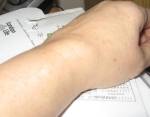
Early in December, I wrote about falling in the tub and breaking my arm. Controlled person that I am,  I stayed calm.  I stepped out, dried myself off, took a photo of my mishapen wrist, dried my hair a little, plopped a bag of frozen peas on the bulging break, found a book to read while waiting in emergency, called my neighbour and asked if he could give me a lift to the hospital, and poured a coffee into a travel mug for the twenty minute drive there.

I wasn’t prepared to break my wrist, but I wanted to be damned prepared for my time in the emergency department!

When I arrived at 1:30, there were seven or eight people ahead of me, all waiting to talk to the triage nurse and be assessed. It took ninety minutes for me to make it to the front of that line, and another seven hours to be examined and treated, and during that time, I had front-row seats to a bizarre soliquoy being delivered by the patient in front of me. It was obvious that she, unlike me, was not all there. Still, I was a captive audience, and I couldn’t help but feel compassion for her.

She was in her fifties, and likely very pretty at one time. Now, her graying hair was long and unruly, her face pale and surly. She had broken her ankle weeks before and wore a hard plastic walking cast over her pant leg. Today, the problem was not the ankle. It was her other leg. She sat in a hospital wheelchair and imaptiently rolled it back and forth in agitation, occasionally running into the legs of the young woman in front of her.

“I was getting off the bus to visit my psychiatrist and the stupid bus driver pulled away before I was on the sidewalk and knocked me down. I’ve hurt my knee badly. Oh, God, it’s so sore,” she cried.

“I lost my job working in Dr. Martini’s office and now I’m on welfare and I can’t afford a taxi and I don’t even have enough food. How do they expect a person to live?”

Then again, in case someone had missed it before “I was on the bus and the stupid bus driver, etc.”

She went on and on about the things that had befallen her over the past five years, told the crowded waiting room that she’d had custody of her daughter’s child but he was taken away, told us how unfair her previous employer had been.

Eventually, she forgot that her leg was supposed to hurt. She got up from the wheelchair, walked to the security guards, loudly complained of thirst and started swearing about the long wait, about being alone. Someone brought her a can of pop and she started to cry again, big, sniffling sobs interjected by words of gratitude.

That’s when it hit me. Five years before,  she may have seemed like anyone else: likely still attractive, with a job that required intelligence and responsibility. Something caused her to lose it. That either began her downward spiral, or was one of the major steps on the way down.

It can happen to any of us. Tragedies and stresses can bring to the brink. Something within either tells us to hold on, or to loosen our grasp and allow a freefall. I have been hanging on.  When I list the negative stresses of the past five years, I wonder how I’ve held on and escaped her fate. Is it just that my fingers are frozen in  their grip?  Will a time ever come when all I’ll be able to talk about is the litany of things that went wrong?

I refuse to allow that to happen. I’ll concentrate on all that is good around me, because there is so much to be thankful for. I’ll try not to dwell on the stresses around me. I will voice them now, a purging perhaps, but I will not think of them again today, nor tomorrow: the elderly father struggling to master the use of a prosthesis, and being hit with pneumonia three weeks into his rehab; the husband who’s been too often been the victim of buyouts and restructuring over the past five years; concerns over our retirement; the bravery of a dear friend who’s been fighting cancer for what seems like forever; our sadness for her husband, our oldest and best friend; the sudden death of a beloved pet; the helplessness of watching a son’s heartbreak over a broken engagement and another’s uncertainty over a lifelong  career; and my own health issues, now more of a concern by this neverending circle of worry.

Yes, when I find myself obsessing over the things I can’t control, I’ll remember that poor woman in emergency, and I’ll think of my many  blessings. There is a fine line between us, but unlike her, I am not facing life alone. And that, I believe, is what will make the difference.

22

The shrill ring of the phone slices through my quiet
and the somber voice on the line roots me to the ground.
“Annie is gone.”
His words echo through the wire.

Later, dread in each step,
we approach Glen’s tiny senior’s home,
Identical to those left and right,
the pain is still contained there,
not yet bleeding
through the peach-coloured brick
nor obliterating the “welcome”
in the sign that hangs.

A hesitant knock
beckons the shadow
of our old English friend.
Arms wide, he accepts our long embrace
then ushers us inside,
where classical music plays faintly
and lights stay dimmed.
Before we can ask
he begins to speak of her;
her sudden, cruel decline;
the agony of his helplessness.
He struggles to breathe evenly,
as he tells us, in disbelief,
that her first thought was of him.

”But what will become of you, Glen?” Annie had asked.
 
Her question lingers,
hangs in the air
like a mourner’s veil.

His eyes raw, his voice breaking,
he repeats her words, is
puzzled, in disbelief of
her bravery, the selflessness
of facing her own death
but fearing for him.

There is no reality here.

We are still life,
mere points of colour
like the figures on Annie’s tapestries
that surround us now;
each scene to remind her of her homeland,
months of painstaking needlepoint stitches.

She is gone but she is everywhere.
Glistening cabinets
display crystal birds
and delicate china ladies.
Just dusted?
The ever-present candy dish,
entices.
Newly filled?
Proud homemaker,
perfect hostess still.

On the bathroom shelf,
favorite perfumes wait,
perfectly aligned.
Her open cosmetics bag rests
upon the hand towel.
Just used?
Atop the polished bedroom dresser,
precious rings lay
upon a tray;
beside them, silver-framed photographs
are arranged with care.
Our family from a simpler time,
our scrubbed young sons in suits;
no family for Annie to call her own.
Glen rises,
says he feels such thirst
and walks into the kitchen.
“Do you like yogurt?” he asks.
Cups of yogurt, her last attempt at food,
are stacked upon the shelf.
”Please take some home,” he says.
But instead I stare
at the open door
where fuzzy fridge magnets still reside,
and I remember hours of amusement
for our boys so very long ago.


We are but marionettes
suspended in an eternity;
reading from a foreign script;
searching for understanding;
clutching threads of normalcy.
”I would try to make her a shake,”
he continues.
”Yogurt and ice cream
and maybe some fruit.
Mix it all in the blender.
She liked that.”

His hand shakes as he reaches
for a fresh tissue to wipe new tears.
And I am like stone,
sitting across from him
in a straight-backed chair.
Just reach out, I think,
do something to help
slow the shudder in his voice.
Instead, I turn my eyes away
and see, for the first time,
a framed picture of a young Annie,
flirting, hand on jaunty hip.
Tears rise at the flashed reminder of her spirit
and I watch as my husband
tentatively touches
his old friend’s shoulder.
He asks “Have you eaten?
Are you hungry?”


”I think I’d like a pizza.
There’s a Pizza Hut nearby
where Annie and I often go.”
Then he shows us the new leather jacket
Annie insisted he buy for himself
for Christmas…
mere weeks ago.
“It is lovely,” we say.

And I think how strange
to discuss the merits
of cowhide over lambskin
when life has been so altered;
to debate thick crust over thin,
to need to eat,
to dine amidst smiling faces,
and have no stranger recoil
from the shock and grief
that is worn like a cloak.
The drive back is dreamlike,
our talk of mutual friends,
innocent memories amidst
flashes of Glen’s disjointed thoughts:
”Must close some old bank accounts.
Have to write to Germany
about Annie’s pension. What about her jewelry?”
A few moments of quiet, then “They’ll make me move
to a smaller unit soon.”

And before
we can say any
of countless words
we want to say,
know we should say,
we are back
where death is too familiar,
returning Glen to his home of memories.
At his doorstep,
our solitary friend,
collar turned up against the cold,
a leftover pizza box
clutched in one hand,
waves a faint good-bye.
It has grown late.
Our long drive home is thick
with silent reflections
of life so long ago:
Glen, disillusioned and newly single at mid-life,
and Annie, so needing to love;
her mischievous eyes, the throaty laugh,
her bravado in facing illness and age,
her delight in the simplest
of life’s pleasures,
and her greatest joy:
her years spent as Glen’s wife.
And Annie’s question haunts me
as we journey home that night.
Just what will become of him?

Dedicated to the memory of Annie Stout 1928-2002


border-21On July 20, 1999, I am reminded to count my blessings.

~~~~~~~~~~~~~~~~~~~~~~

A LIFE BEYOND PERFECT

In four short days, I have learned of five deaths, most unrelated but all with the bitter taste of needless loss. They were young, distanced from the reality of their own mortality. I find myself dwelling on the loved ones left behind, and the agony they are forced to endure, because I have lived their pain. I am jarringly reminded that in the end, there is only birth and death that matter, that the charmed, happily-ever-after lives we so achingly strive for are just insignificant backdrop when death beckons.

The first death was the son of a beloved president whose public assassination shocked the world. I close my eyes, and see John F. Kennedy Jr., just three years old and the epitome of innocence, saluting as his father’s funeral motorcade drives by. I remember my mother’s words “God only gives you what you can handle” and “suffering makes you stronger.” I wonder why this family has been chosen for such sorrow, and I am sick that once again they’ve been broadsided by senseless tragedy. I tell myself that life is not a game in which moves are strategically planned by a master player, that there is no logic or fairness in the roll of the dice. I try to let go of the subconscious hope I have unknowingly held for years: that this son of a slain president, who had seen so much tragedy in his short life, would rise and carry on the reign of a slain and beloved king; that “Camelot” would be restored. I have been holding on to a fairytale, like so many others, waiting for a hero prince to return from exile.

His death is not solitary. With him are two beautiful sisters, one living a Cinderella dream in her marriage to John Kennedy Jr., the other’s life barely lived. I sense the pain their parents must feel, the cruelty of charmed lives cut short.

A day later, the eight-year-old son of a vice-president at my husband’s company wakes up with a headache. By mid-afternoon he lies in a coma. He dies a few short days later, never waking. They are strangers, these parents, living hundreds of miles away, but I think daily of their anguish. I am sick with the realization that they had no warning, no way to prevent or prepare. I dwell on how perfect their lives must seem to outsiders. They are young, affluent, successful. Without ever meeting them, I know they would relinquish everything for the return of their child.

This weekend, a young man, just twenty, dies in an automobile accident. Up too late at a party, he waits until completely sober to drive home, then falls asleep at the wheel. I recall the chubby, red-faced twelve year-old struggling to save goals on my son’s soccer team; his parents at every game, their precious Yorkies tucked inside their jackets.  I remember my envy of his mother, the founder of her own private school, an accomplishments teachers like myself can respect. Her son grows into a handsome young man, polite and full of promise. Her pride in her career pales in comparison to her joy in her son. It is a drop of water compared to the ocean of heartbreak she now faces.

It is near noon as I contemplate these sad losses. I have driven my eldest son to work and my youngest son of twenty still sleeps. The careless signs of their presence in our home often upset me. Today, my car holds empty pop cans, a pizza box, candy wrappers, and less gas. As I enter our home, my gaze wanders to the unswept grass clippings in the driveway, the shoes left scattered, yesterday’s opened mail on their placemats.

I walk down the stairs to the family room that is their favourite space. Dishes arae left on the coffee table, the unscraped food hardened. Video game’s controls are stretched across the floor, and clothes, once left folded on the billiard table for them to put away, are now askew, beds for our many cats.

Tentatively, I walk down the hall, ready to see the unkempt rooms that make me despair, but today, I feel different. There is no anger as I see the unmade bed of my eldest, or the disorganization of his pat-rack existence; and as I watch the still-sleeping form of my youngest son, I don’t feel my usual frustration. I glance at the evidence of what I have often considered an irresponsible life: the late nights after his restaurant shift, the clothes in disarray, a carpet that needs to be vacuumed. All I feel is relief, because this morning I realize how lucky I am to still have my sons. A sense of peace fills my heart as I quietly close his door, and turn to walk away.

In our country home, with two parents, two sons, and four cats, we do not lead charmed lives when seen under the daily microscope. But I have known loss, and this week has reminded me that sloppy rooms matter nothing when viewed next to the harsh reality of a child’s mortality. Today, my life is beyond perfect.

PB170397 bigger another

I visit this space two or three times a day, drawn by an overwhelming urge to write. With one arm in a cast, it’s just not going to be that easy. Five minutes of trying and my one good hand is stiff and sore and wanting to slap me. While I “not-so-patiently” wait to heal, I thought it might be a good time for this old piece, written about my father five years ago. Since so much of my life right now revolves around his health and rehab, it seemed an appropriate time to share a little more about him.


WITH  MY DAD, IT’S ONE STORY AFTER ANOTHER


Recently it was my father’s seventy-seventh birthday, and as always, his family gathered together to toast his longevity. The truth is, though, that we celebrate much more than that, because his wit and zest for life are contagious, and without him our lives just wouldn’t be the same.


Dad defies the calendar – he seems to grow younger by the year. In fact, last summer, he traded his older, staid Cadillac for a Grand Am. He joked that he also intended to grow his hair long, get an earring, wear his pants lower and use his new, sportier car to attract women!
 
He lives in the moment. There is a wonderful quote that he may never have heard, but he lives it nonetheless:
 
Life is not a ride to an end, with the intention of arriving safely in a pretty and well-preserved body. Skid broadside to the grave, used up, worn-out and loudly proclaiming “Wow – What a ride!”
 
Yes, he views life as an adventure, and as a result, he’s had more than his share of “misadventures,” from which his funniest stories are born. It started in his youth. As the second oldest in a family of nine, opportunities for practical jokes were abundant. His stories of their mischievous pranks and foolhardy play are endless.


As a child, one of my earliest memories is seeing him swing between crutches, only to lose his balance and re-break a foot. Even then, he loved to make us laugh. I can close my eyes and still see him performing his bicycle trick: the handlebars of a bike turned around and Dad sitting on them, faced backwards and blindly trying to navigate figure eights between the trees of our backyard, while we squealed in a mixture of delight and alarm.


He’s a widower, so nowadays he’s by himself when most calamities occur. I suspect he uses the time between our visits to rehearse his “delivery” of his latest comical escapade. Between the speed of his “Maritimer” speech and his laughter as he relives the experience, it takes all of our concentration to figure out what he’s telling us.
 
His tales are legendary, and many have occurred while on his many road trips. One incident happened years ago while camping. A freak windstorm suddenly began to uproot one side of his tent. The gales caught his air mattress and began to carry it across the fields. Dad was already well into middle age, but he chased it, hopping fence after fence. The mattress remained just out of reach, until finally, in desperation, he threw himself on top of it. There he stayed through the entire storm, spread-eagled to keep the mattress down, until it was safe to stand up again. He carried it back to the campsite, only to see his tent was gone. He eyes scanned the surrounding ground and saw no trace of it but then he looked up, and there was the tent, snarled high in the branches of a nearby tree.
 
On a more recent journey, he stopped to eat his boxed lunch at a picnic area adjacent to a truck stop. When he was done, he tidied up, tossed his garbage into the bin and resumed his journey. One hundred miles later, he realized his mouth felt mysteriously empty. For some reason, he’d taken out his dentures, then inadvertently tossed them away with the garbage! He turned around and high-tailed it back to the picnic area, only to discover the garbage truck had just done its pick up.
 
This week, he almost met his maker while coming out of a Canadian Tire store. He was carrying a heavy bag of ice salt, and chose the ramp rather than the stairs to get to his car. Turned out to be solid ice. He managed to stay on his feet, but went straight down in one slide. Said he figured the weight of the salt had given him extra momentum. Problem was, he couldn’t stop. Not to worry, though, because he got some assistance. Body-slammed straight into a shed at the bottom of the ramp. Never did drop the salt, though, he bragged.
 
Staying sedentary for too long makes him antsy, so he’s always willing to take on a new handy man challenge. Educators would tactfully call him a creative problem solver. He adds a whole new dimension to the word “resourceful.” Just last month, he installed my sister’s dishwasher, made even more challenging by having to improvise with an old hose. He later explained, in minute detail and with some pleasure, how the exploding hot water actually blew the cupboard doors open. And this summer, he managed to single-handedly put up his backyard patio canopy, a job for three people. Of course, not before having the whole thing collapse on top of him, then having to crawl out sheepishly, eyes peeking furtively from under to be sure no one had seen him.
 
He’s just not your average senior.
 
Not that he thinks of himself as one, either. Just this past summer, he was out bicycling, and came up behind an elderly lady out for a stroll. Said she was a “senior” and may get startled easily, so he didn’t signal with his bell. Instead, he maneuvered to go around her. Big mistake. The wheel of his bike got caught between the sidewalk and the grass, catapulting him over his handlebars and onto the ground in front of her. To hear him say it, it was uproariously funny, even though he’d banged and scraped his forehead and his knee badly. His biggest concern was that he’d nearly given “the little old lady” a heart attack.

 But thankfully, he has learned to take care of himself in other ways. Says he takes that “ecca stuff” to ward off colds and swears by Vitamin C and garlic. And he’s learned to be careful in the sun. Uses sunblock before he goes outside to garden now. He just has to be a little more conscientious about reading labels

The last bottle of sunscreen he generously smeared all over his face got awfully tight after about twenty minutes outside. Said he tried to wipe it off with a tissue from his pocket but it got stuck in shreds all over his face.

Turned out he’d used Elmer’s Glue.

If you wonder, as we often do, how he’s doing after living through all of these misadventures, this is what he told callers whenever the phone rang on his birthday.

He picked up the receiver, and instead of saying hello, simply said “Seventy-seven and still mobile.”

You’ve got to love him.


~~~~~~~~~~~~~~~~~~~


Epilogue: At the age of eighty, he traded the Grand Am for a newer car, a turbo-charged Grand Prix.


OUT FOR REPAIR

broken4I have loads to say about my father’s leg amputation last week. My emotions have been all over the place and hours in hospital waiting rooms inspire all sorts of writing ideas. Unfortunately, some of it will have to wait for a bit while I nurse a broken left wrist. Alas, I am but a cliche. I slipped in the tub, and life has just taken a definite change of course.

Typing with one hand isn’t easy, particularly if you’re groggy from pain medication. But trust me, the words are going to find a way out, even if I have to use my voice recognition software.

There are stories to be told – not to mention angst-loaded essays on the Ontario health system.

Watch this space.

Another oldie for a busy day. It was written five years ago but the truth still applies.


Roseanne Roseannadanna got a bum rap. People laughed when the late Gilda Radner’s alter ego said, “It’s always something.” But she was right, and if harried country dwellers weren’t so busy, they’d surely get together and elect the hapless broadcaster their patron saint.

Take our family, for example. Lately, life feels like one calamity after another. Granted, much of the chaos has been around family health issues that rendered three of the four of us immobile at one time or another. I’m practically on a first-name basis with the hospital staff and my pharmacist has jumped to the next income tax bracket on our business alone. So I really don’t need any more upsets in my life.

Add to that the fact that I’m married to the world’s most fearless do-it-your-selfer, and you may get a hint of the chaos in which I live.

Our house is “getting on,” and it feels like we’ve been renovating constantly for the past two years. Last year it was the main bathroom, then the deck. He drained our pool and began excavating around it to convert it into a pond, complete with bridge and water wheel. Last month, he removed our carpets and installed new flooring, then ripped out and rebuilt our staircases.

Don’t get me wrong. I love the fact that he’s willing and able to tackle so much, but so many projects on the go can wear you down. It feels like every room in the house is serving as a tool shed, and we’ve lost all control of the inventory!

But back to my point in writing this diatribe. Once again, there is critical illness in our home. This time my loved ones are all fine, but the health of my furnace is a whole different story.

Here I am, on a country road, open to acres and acres of farmers’ fields on three sides, and going through one of the coldest winters I can remember, and my furnace has croaked. Granted, it’s been terminal for about a year now, but we’re firm believers in recussitation. It’s been on life support for a few winters now.


But on Friday morning, around 5A.M., it gave its death cry. It screamed in misery, broken metal clashing within, forcing my husband to disconnect its power and investigate. Diagnosis made, we began our search for a replacement part, only to find it no longer existed. Apparently electric furnaces get a head start on obsolescence.

Luckily, Mr. Fix-Everything-Somehow managed to do a makeshift repair so that we had heat by Saturday afternoon, before the temperature in the house could dip lower than fifteen degrees. But our squeaky, power-guzzling friend will have to go. Not that I’ll miss it. Last month’s hydro bill was over $800.00, due two weeks after receipt. Over a year, spending close to $4,000 on electricity is not unusual for us. That in a time of privatization. Very scary.

Of course, being in the country, we have no gas lines to access, so it looks like we’ll have to take the plunge and convert to propane. Ugly tank at the side of the house (which I hope to camouflage), and we’re promised lower bills. Spooks me a little though, despite reassurances from my husband. I can’t help but imagine riding high on a gigantic fireball one day.

It turns out we’re going to need the extra savings, too. Our old lawnmower/snowplow combo (which has recently received a “Junkyard Wars” rendition of a plexiglass and plastic enclosure) dropped dead yesterday before we could get our long, country driveway cleared. The drifts are now past my knees.

Yeah, Roseanne Roseannadanna was a woman of great wisdom. It really is always something. Think she was a country girl?